Every Cat Fountain Sold Today Is Making Cats Sick — Except One
Independent Cat Health Reporting

A Veterinary Op-Ed

Every Cat Fountain Sold Today Is Making Cats Sick — Except One.

If there's pink slime on your cat's fountain three days after you scrubbed it — and you've never asked how that's even possible — read this.

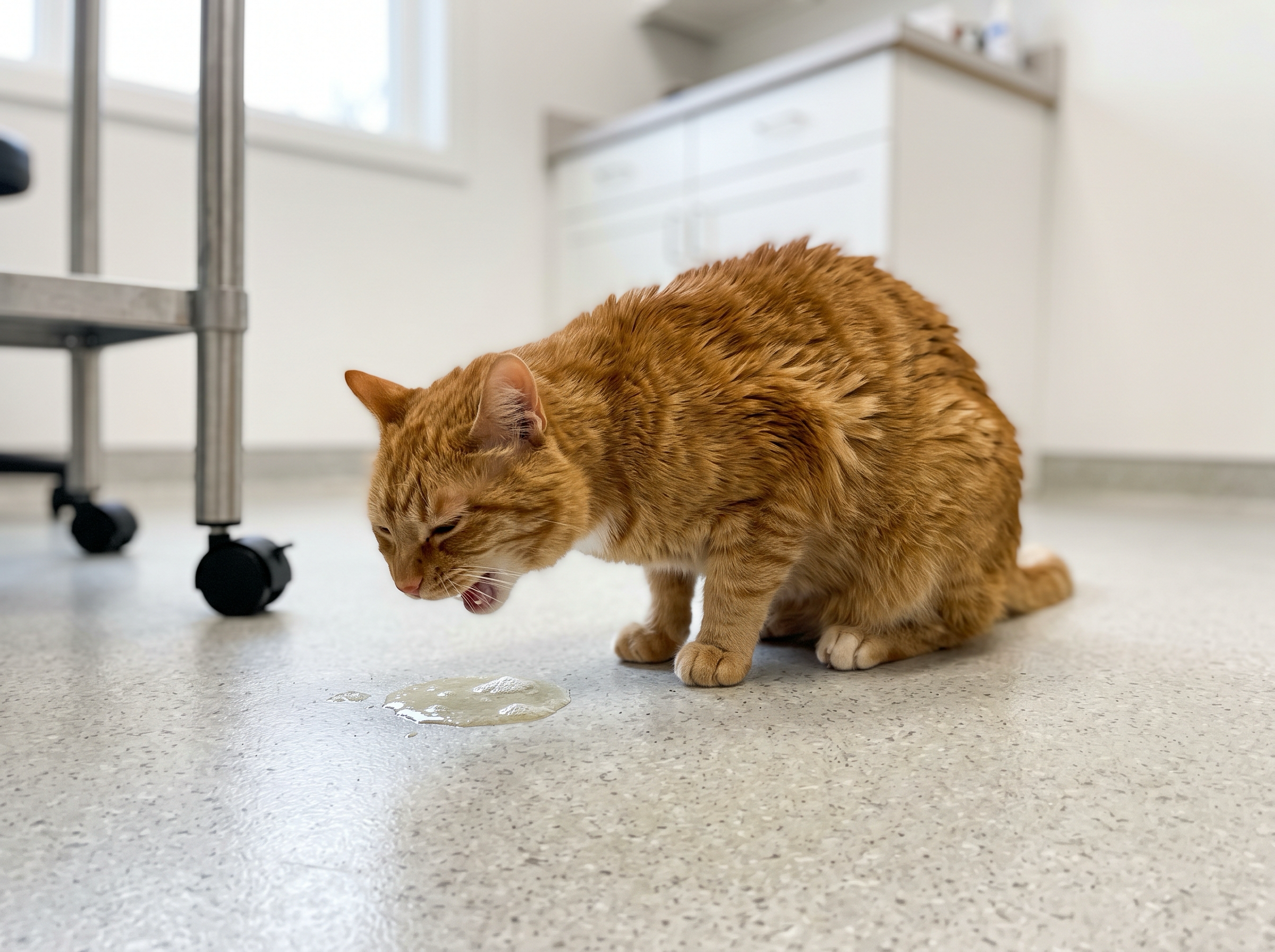
An orange tabby cat hunched low on a speckled clinic floor, head down and mouth open mid-retch, with a small puddle of pale-yellow bile on the floor in front of it. A stainless instrument cart and a bright white veterinary exam room are softly out of focus behind. Visibly unwell.

I'm not a veterinary influencer. I'm a small-animal vet in Fort Collins — ten years in practice, mostly cats. Two of my own at home: Theo and Maple.

I see about sixty cats a week. And the same handful of problems keep walking through my door: recurring bladder infections. Chin acne. Stomach upset that won't quit.

More often than not, it traces back to the one thing the owner trusted most — the water bowl. Specifically, the fountain.

I've thrown out two of them myself. Spent too many Sundays scrubbing pink slime off plastic with a baby toothbrush before I admitted what every careful owner eventually does: the cleaning was never the problem. The fountain is — because of what a fountain actually is.

What follows is the case I'd put in front of the FTC if anyone there was listening: why every major brand on the shelf is built the same broken way, why they keep getting away with it, and the one design I now recommend to clients instead.
The case, part one

The Design Flaw Every Major Cat Fountain Brand Knows About — And Sells Anyway.

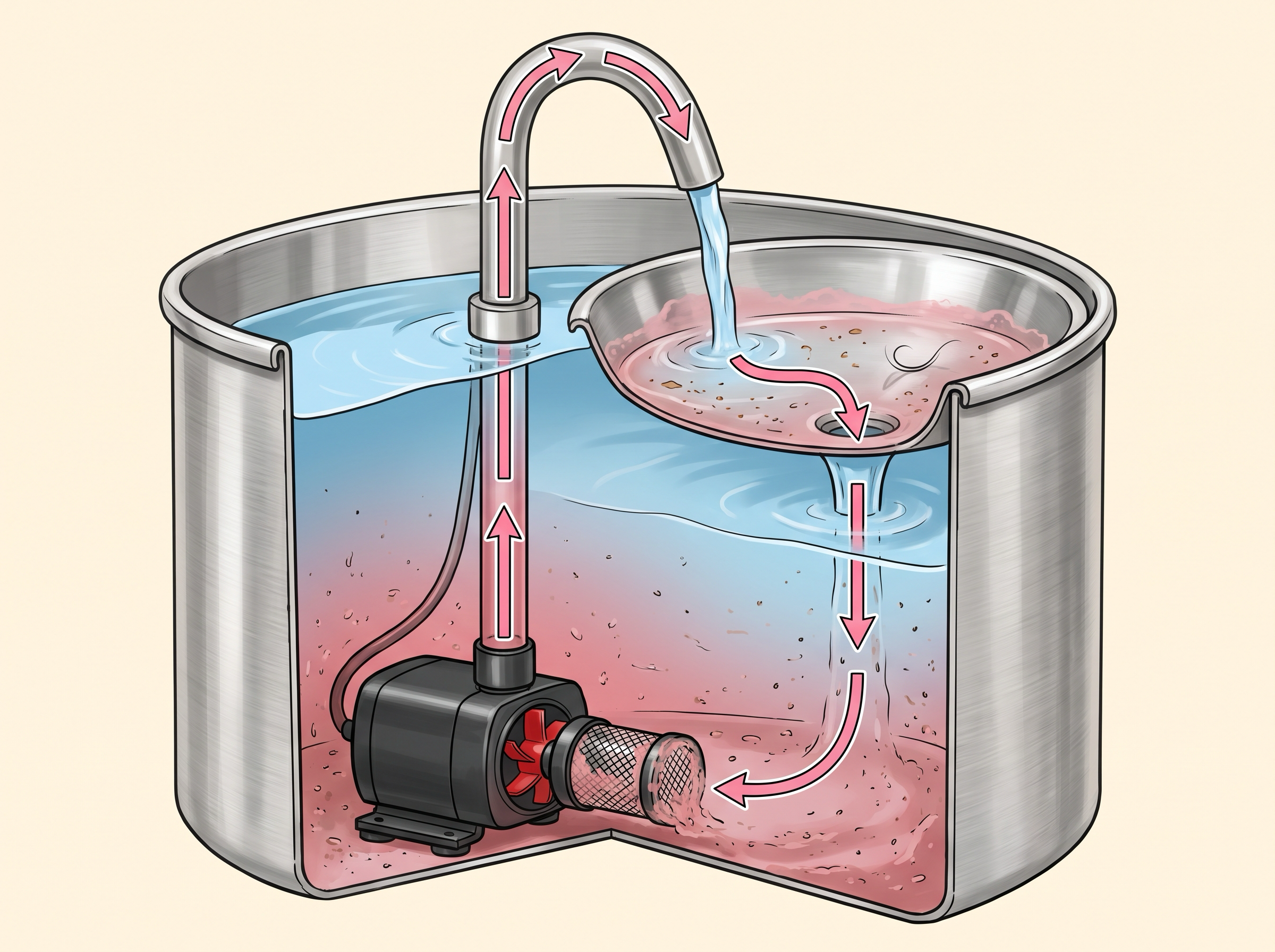
Cutaway illustration of a stainless-steel cat water fountain showing the inside: a drinking bowl on top and one open reservoir below. The water is clean blue at the top and murky pink-red at the bottom, where a black submersible pump with a red impeller and a mesh carbon filter sits. Pink arrows trace a closed loop — water pumped up the spout, into the bowl, draining back down into the reservoir, and sucked into the pump again. The same water, recirculated.

Open any cat fountain on the shelf — plastic, stainless steel, ceramic. Different shells. Same machine inside.

It's a loop.

Water sits in a bowl. A pump pulls it down, pushes it back up through the spout, and it falls into the bowl again. Down, up, over. Hundreds of times a day. The same water — for days, until you clean it.

So when your cat drinks — and leaves a little spit, a little shed fur, the food crumbs off her face — none of it leaves. It just goes around. And around.

It's a hot tub with no drain, sitting next to the food bowl, with a little motor gently stirring it. You're not cleaning that water by running the pump. You're stirring it.

And because their pump sits down in that dirty water, it makes everything worse: the motor warms the water a few degrees — exactly what bacteria want — and hair winds around the spinner inside it until it dies, usually within the first year.

That's also why the pink film is always back by day three, no matter how hard you scrub. It isn't dirt you wipe off — it's a living colony, and it survives in the seams and the inside of the pump housing you can't open. You clean the part you can see. The part you can't reach reseeds it the second you refill.

The bowl shape changes. The loop doesn't.

What I see in clinic

Why Recirculating Water Is Making Your Cat Sick.

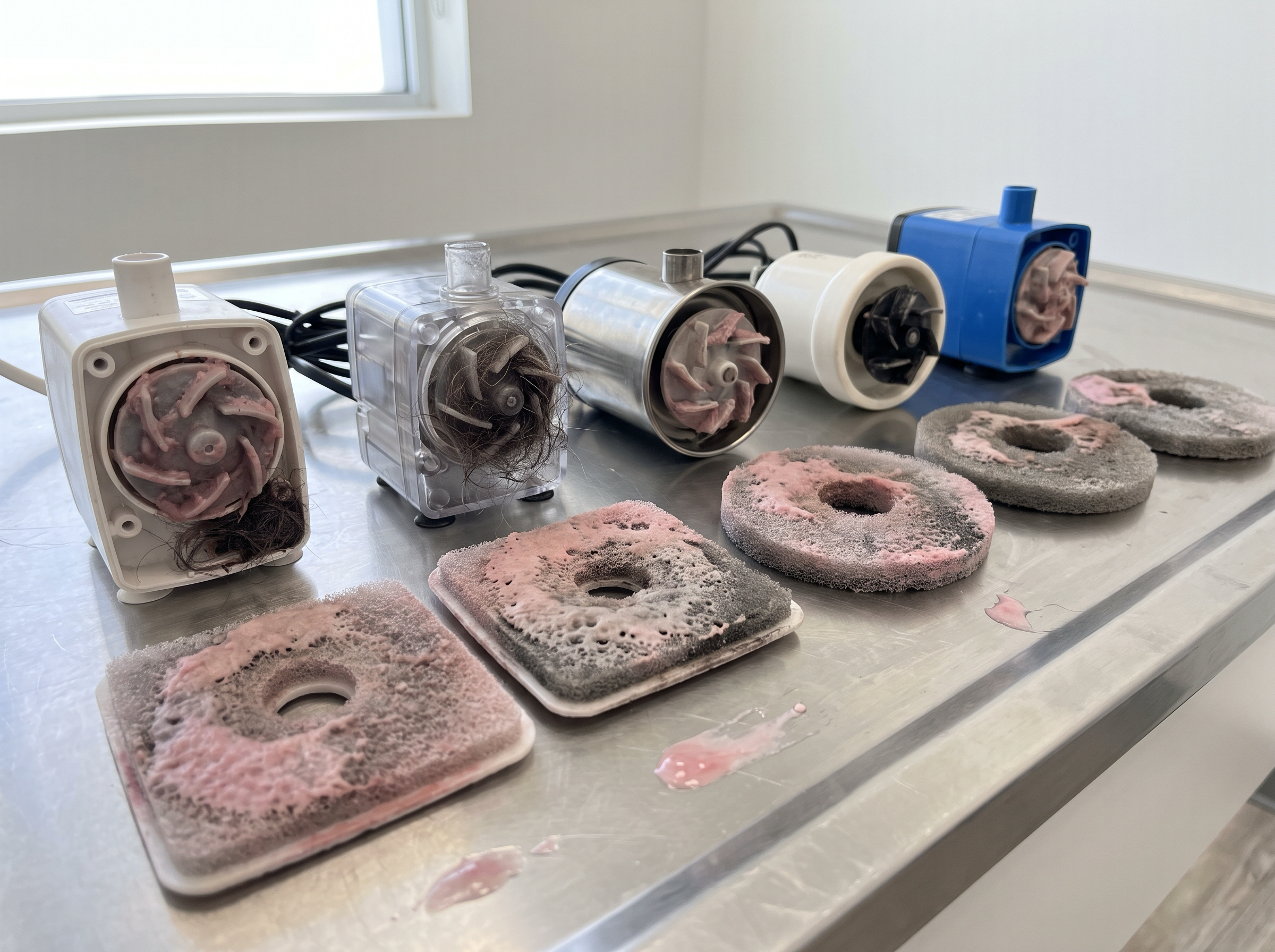
That pink slime has a name: Serratia marcescens. It grows on any wet surface in under 24 hours, and it grows fastest in warm water that never gets replaced — which is exactly what's in your cat's bowl right now.

On a stainless steel clinic exam table, a lineup of five cat water fountain pumps from different fountains, each cracked open to show its impeller caked in pink-grey biofilm and tangled with dark cat hair. In front of them, several flat used fountain filter pads — square and round foam-and-carbon cartridges — stained and clogged with pink and grey slime. Small pink slime smears on the table.

Every lap through that water, the bacteria count climbs. And your cat drinks it. Every time she goes to the bowl. The same saliva-loaded, slime-fed water — down her throat, splashing her chin.

I see what comes next every week. Recurring bladder infections. Stomach upset. Chin acne — the kind that clears up when the bowl changes and comes right back when it doesn't. Owners who did everything right. And the cat still got sick.

And the cats who notice? They walk past the fountain and drink from your cup, the bathroom sink, the dripping shower. That's not a quirk. That's a cat telling you the water failed.

I can't always prove a fountain caused it. But after ten years, I've stopped calling it a coincidence.

The cleaning was never the problem. The way the fountain is built is.

Why they keep selling it

Then Why Does The Industry Keep Selling It? One Word: Filters.

Every fountain comes with a filter. They're sold like they catch the bad stuff. They don't.

A lab study from 1977 settled it: carbon filters don't catch bacteria. They take out chlorine and smell. The bacteria grow on the carbon itself.

The filter isn't catching the slime. It's feeding it — the wettest, warmest, most porous surface in the whole unit, sitting right in the loop.

But it's also the business — and once you see how the money works, you can't unsee it. That filter costs them pennies to make. A pinch of carbon, a ring of plastic mesh — a few cents a unit. They sell it back to you for $4, every two weeks, for the rest of your cat's life.

It's the printer and the ink. Sell the machine cheap, make the real money on the refill you can't say no to. The fountain is just how they get a filter into your house — and the filter is how they bill you forever, for water you already paid for.

And here's what gets me: they're counting on you being a good cat parent. You buy the filters because you love her — and they built the whole business on exactly that: charging the most caring owners the most money, forever, for a part that never cleaned the water.

The filter tax — what they're really selling
1 year26 filters · $4 each · 1 cat
$104
5 years130 filters
$520
10 years260 filters
$1,040
A cat's lifetime~15 years · 390 filters
$1,560
Two cats? Double it. Three? Triple. And the slime is still there.

The turning point

So Are All Cat Water Fountains Bad For My Babies?

No. Not all of them.

The real question was never "is the bowl plastic, ceramic, or stainless" — or even "is the pump in the water." It's: does the used water ever go back through the pump?

If it does — any brand, any material, any filter — you've got the loop. You've got the slime. Forever.

If it doesn't — if the water your cat has been drinking from goes one direction only, away, and never comes back through anything — then there's nothing recycling. Nothing for the colony to ride. Your cat isn't drinking her own spit from last Tuesday. That's the difference.

Here's what a fountain like that looks like:

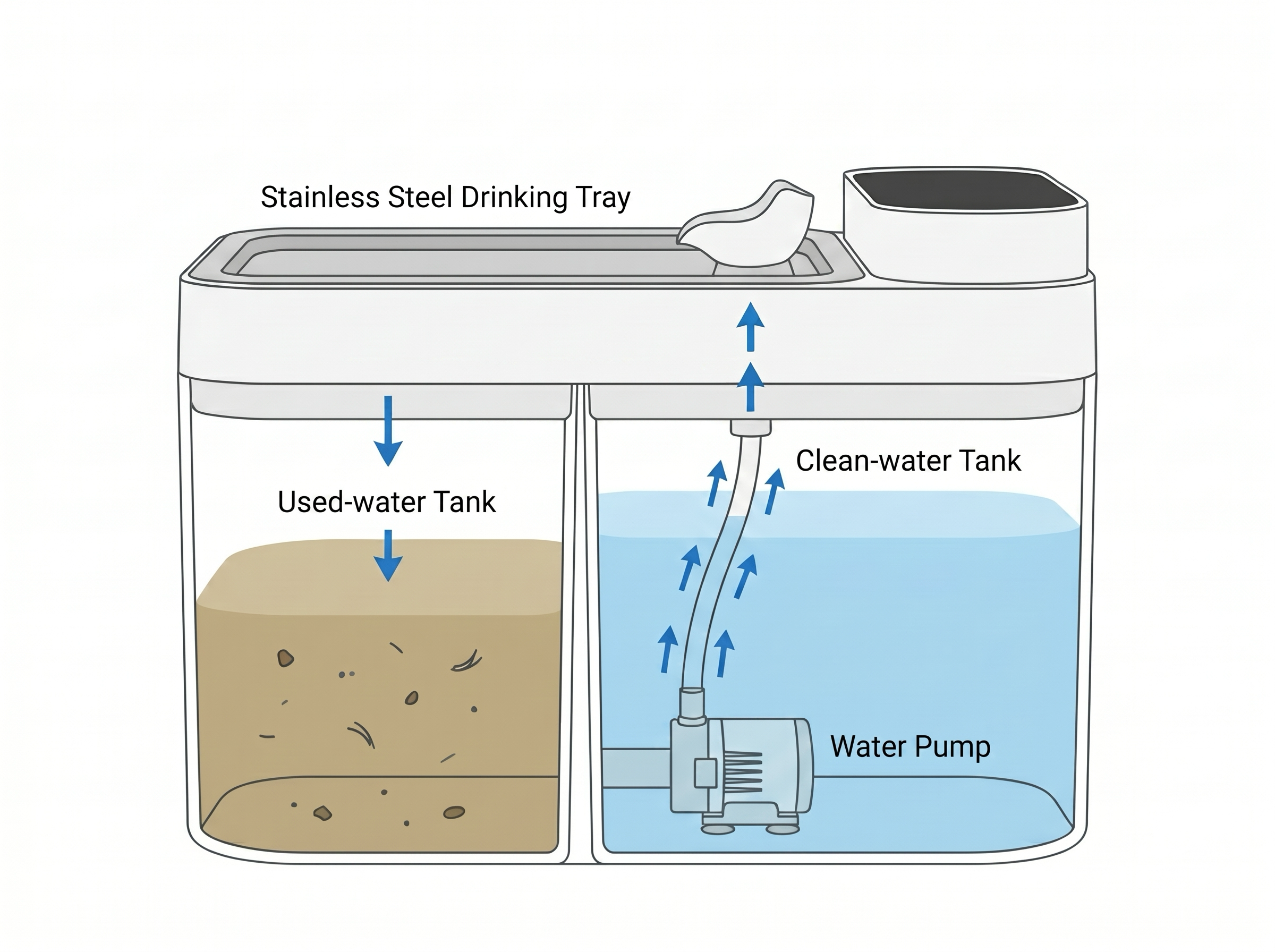
Cutaway diagram of the HydroPurr dual-chamber cat fountain, matching the real product: a clean-water tank on the right filled with blue water with the water pump inside it, and a separate sealed used-water tank on the left holding murky brown water with fur and crumbs. A stainless steel drinking tray runs across the top. Blue arrows show clean water pumped up from the pump to the tray, then draining one-way down into the used-water tank — it never returns to the pump.

And there's exactly one brand on the market actually built this way. You've never heard of it — and there's a reason for that.

The fix

HydroPurr Is What Your Cats Deserve — Not Recycled Water.

It's called HydroPurr — made by a small brand called Tenace. They sell the fountain once — not a new filter every month — so they don't have $50M to outbid the big-name brands on Google. The brands you've heard of aren't the best product. They're the best subscription.

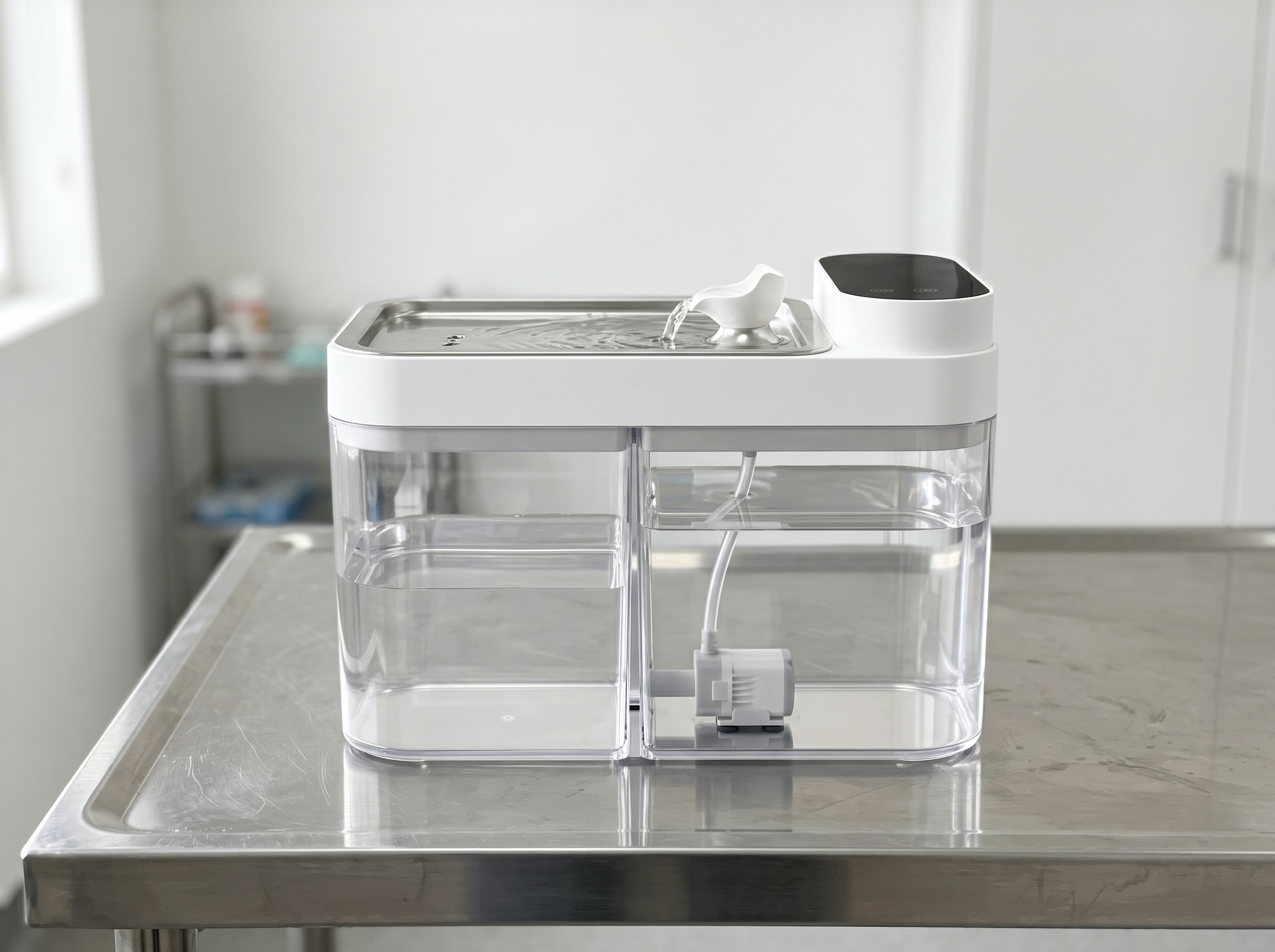
The HydroPurr clear-square dual-chamber cat water fountain on a stainless steel clinic exam table, side profile: two clear water tanks side by side with the white pump visible inside, a white top housing with a black control panel, and a stainless steel drinking tray with water gently rippling. Clean and running, in a bright white veterinary clinic.

Here's how it works.

Two sealed tanks. A clean-water tank, and a separate used-water tank. They never mix.

The pump sits down in the clean tank. It only ever touches fresh source water — the water your cat drinks from never goes back through it. Ever.

Your cat drinks from a stainless steel bowl on top. Whatever she leaves in it — the spit, the fur, the crumbs — stays in the bowl. Then it drains, once a day, straight down into the used-water tank. A one-way trip. It never loops back.

No loop for the slime to ride. No carbon filter to feed — just a screen that catches hair, which you rinse. No pink slime in the pump, because the pump never touches the water she's been drinking. No 25-minute teardown.

The vet steps off the pedestal

I Tested It At Home. Two Weeks. Same Kitchen.

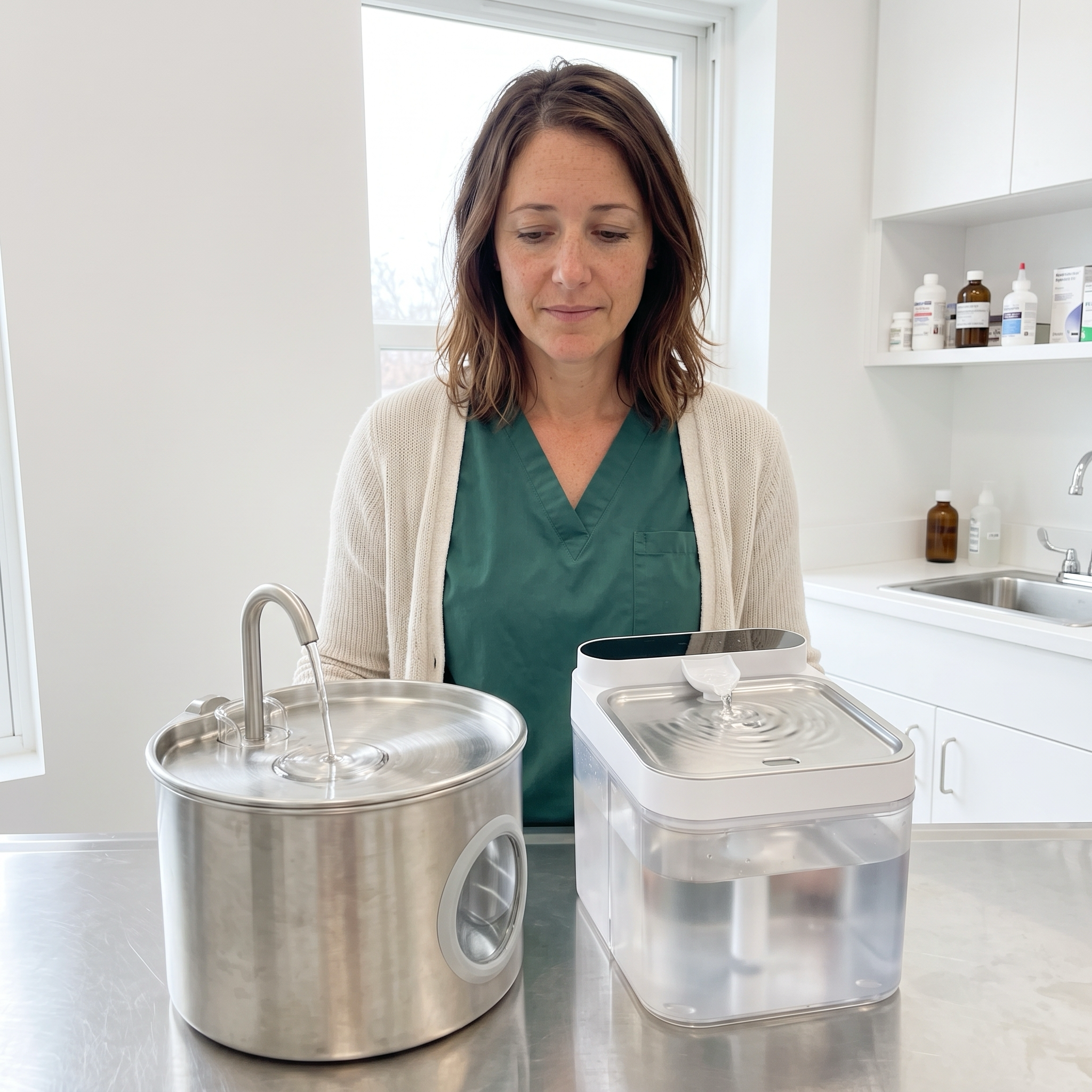
Before I recommended HydroPurr to anyone, I ran it next to my old fountain — a brushed-stainless one I'd been told was the good kind. Same kitchen. Same cats. I gave the old one a full 25-minute deep clean the day before — I wanted it to win. I already owned it.

Dr. Hannah Cole in green scrubs and a cream cardigan standing at a butcher-block kitchen counter by a sunlit window, looking down at two cat fountains side by side — a brushed-stainless cylinder fountain with a gooseneck spout on the left, and the clear-square HydroPurr dual-chamber fountain with its stainless drinking tray on the right. Both clean and running.

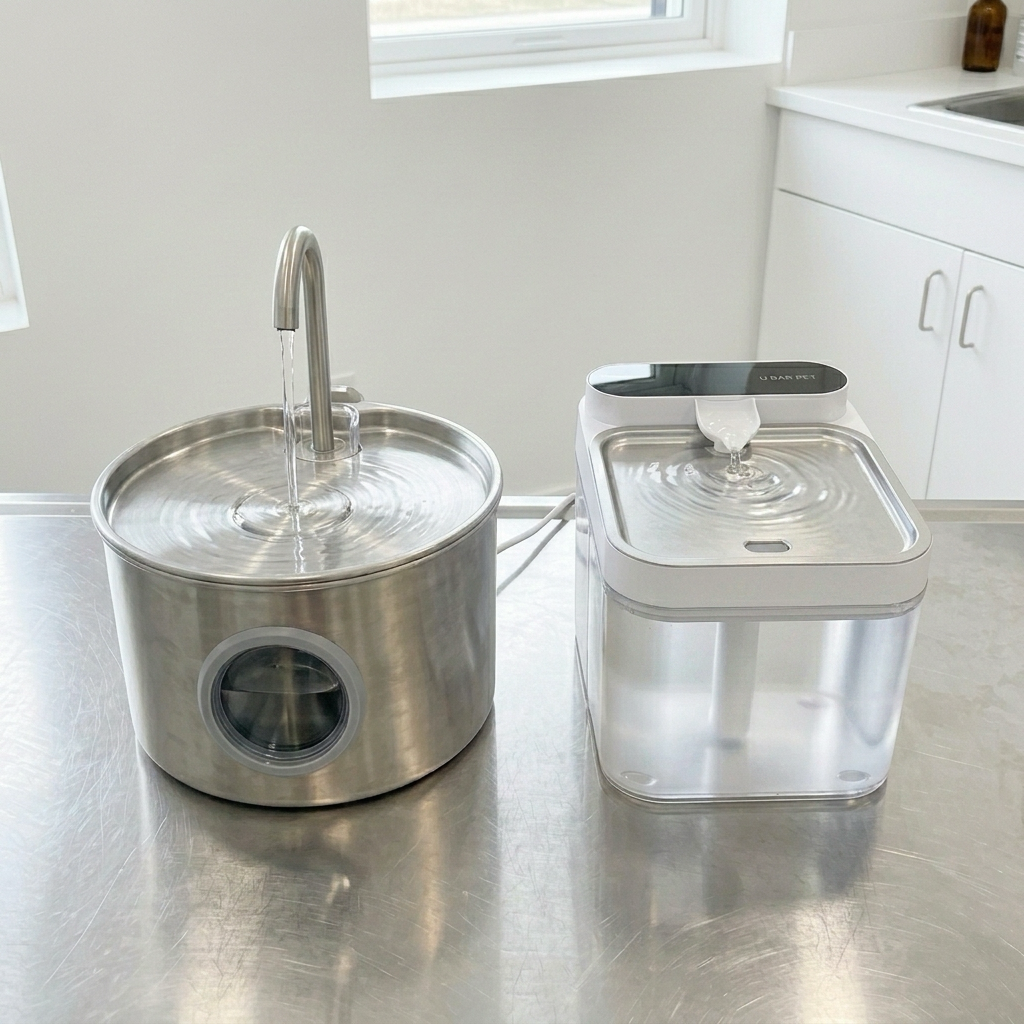
Day 1. Both filled. Both clean.

Day 1 — the brushed-stainless cylinder fountain on the left and the clear-square HydroPurr fountain on the right, side by side on a stainless steel clinic exam table in a bright white clinic. Both freshly cleaned and running, both pristine.

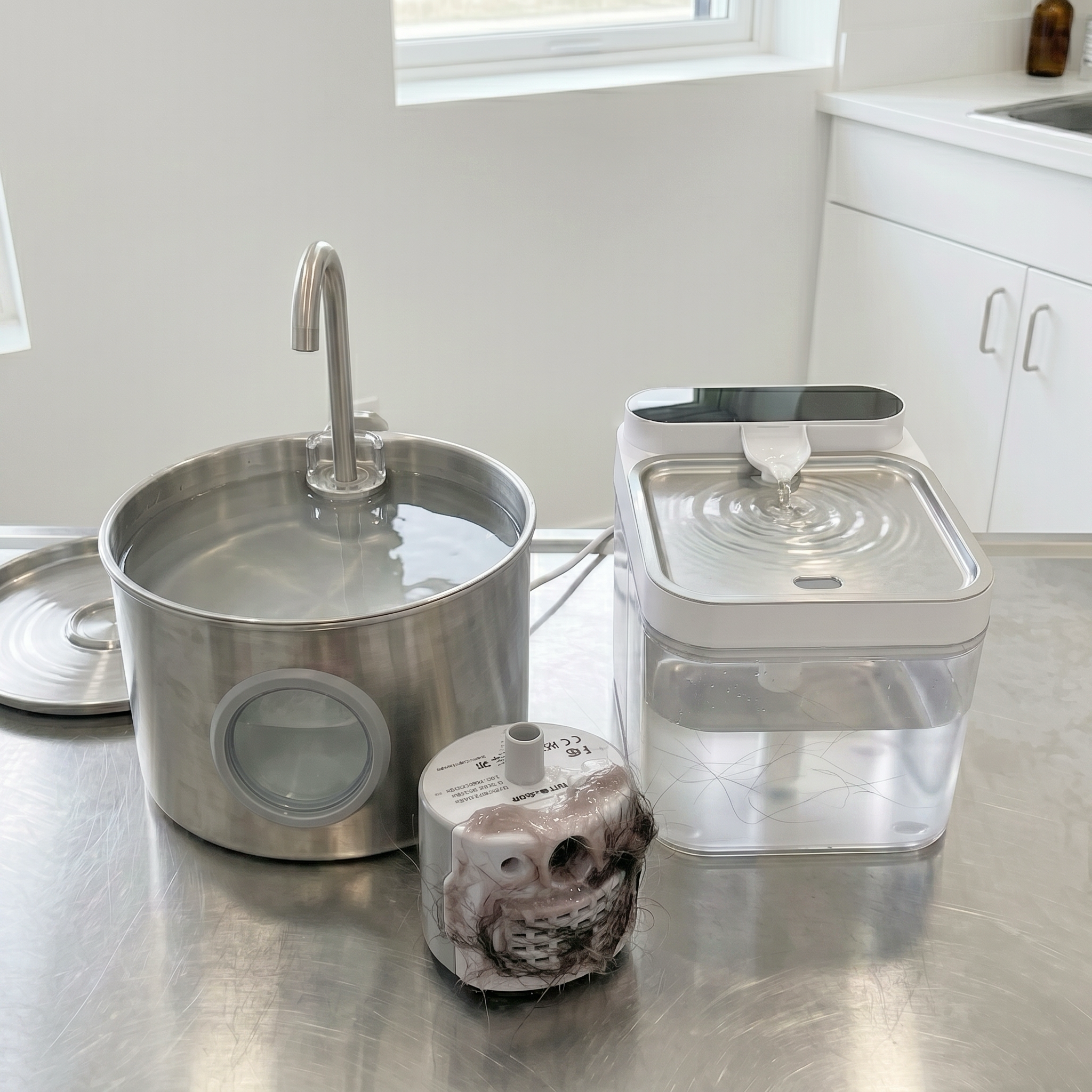
Day 3. I cracked open the old pump — pink slime already growing inside. HydroPurr water? Still crystal clear. (And yes, I opened HydroPurr's pump too. Nothing to find — it sits in the clean tank, not the bowl.)

Day 3 — the brushed-stainless cylinder fountain on the left with its lid off and its pump pulled out and lying on the stainless clinic exam table in front of it, caked in pink-grey biofilm and tangled hair. The clear-square HydroPurr on the right, still pristine and running.

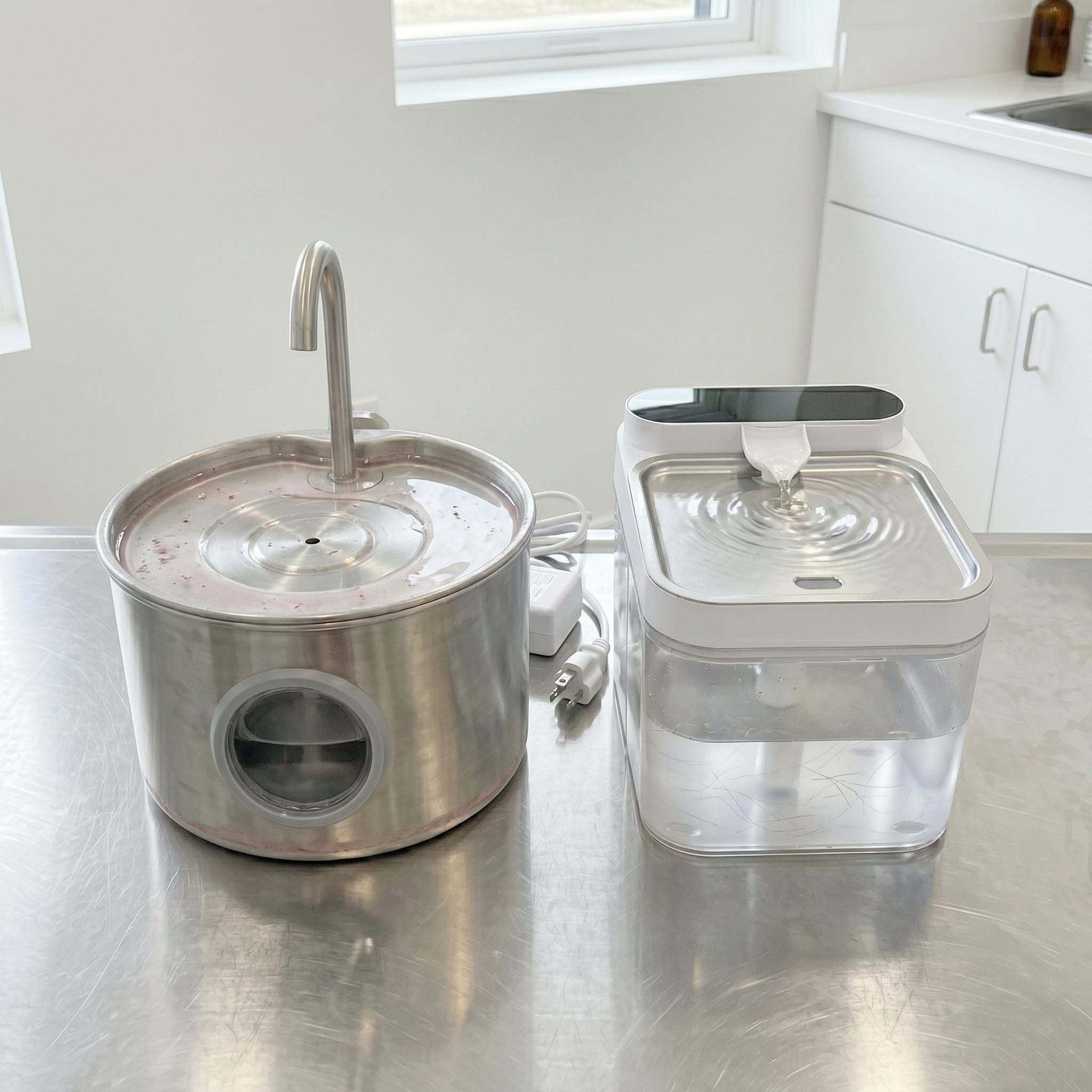
Day 7. Old fountain needed scrubbing again. HydroPurr still clean — all I'd done was rinse one screen.

Day 7 — the brushed-stainless cylinder fountain on the left, its lid filmed with grey-pink slime and unplugged on the stainless clinic exam table. The clear-square HydroPurr on the right, still clean and running.

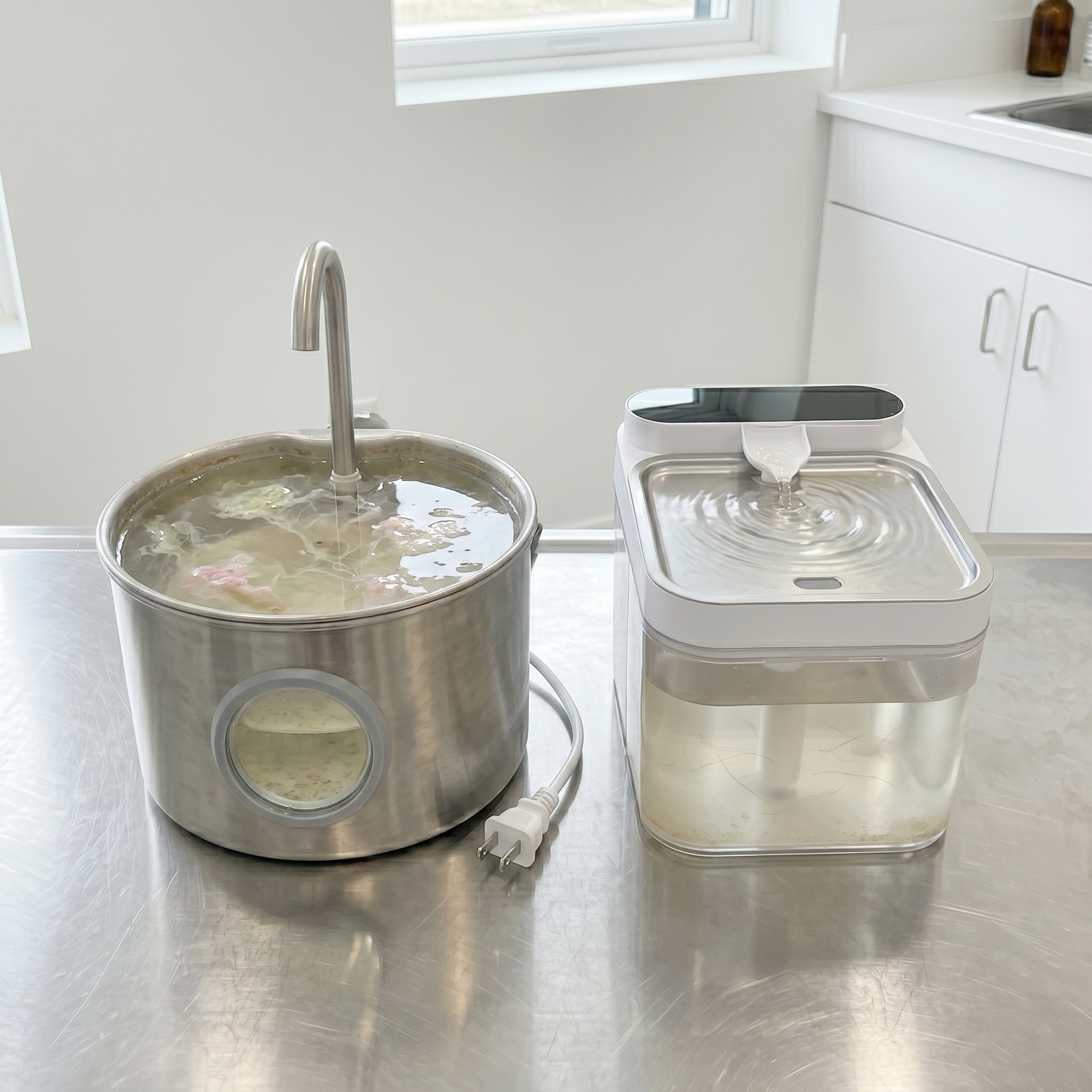
Day 14. Old fountain: I gave up. HydroPurr: still clean. No filter changed. No taking it apart. Screen rinsed once.

Day 14 — the brushed-stainless cylinder fountain on the left, unplugged and abandoned with its plug on the stainless clinic exam table, its water now murky and scummy with grey-pink and green biofilm. The clear-square HydroPurr on the right, still clean and running.

Same kitchen. Same counter. Only the date changed. Day 14, I put the old one in the recycling bin.

But a clean fountain only matters if your cat actually drinks from it. So here's the part those two weeks didn't show you.

Theo and Maple took to it within a day — no coaxing, no slow switch-over. And the part that genuinely surprised me: I track their water with a smart pet scale at home, and over that first month their intake came up about 40% from baseline. For someone who spends every week worrying about dehydration and kidney values in older cats, that's not a number I could un-see.

If you don't want to go back to this —

  1. Unplug the fountain.
  2. Pick it up off the floor.
  3. Empty it into the sink.
  4. Take the whole thing apart.
  5. Pull out the pump.
  6. Mix a vinegar solution.
  7. Soak the pump.
  8. Run it in the solution.
  9. Rinse with fresh water.
  10. Run it again to flush.
  11. Scrub every part with the little brush.
  12. Reassemble.
  13. Refill.
  14. Carry it back to the floor.
  15. Plug it in.

And after all that — the water's recycling again before you've put the brush away.

Then get yourself one of these —

Your whole weekly routine:

  1. Rinse the hair screen under the tap.
  2. Empty the used-water tank up front.
  3. Toss the stainless tray in the dishwasher.
  4. Let it air-dry.
  5. Snap it back. Forget about it.

That's it. Once a week. And even if you skipped it — there's no loop for the slime to grow in. Your cat's spit never touches the clean water.

Let me be straight with you: I'm not affiliated with them and I don't earn a cent if you buy one. It's a small brand, made in small batches — the last client I sent looking had to wait for the next run. After everything I've taken apart, it's simply the only fountain I'd put in my own home.

Get HydroPurr Now →

The Questions I Get In Clinic.

Doesn't the bowl water just recirculate anyway?
No — that's the part that's different. The bowl doesn't recirculate. It gets a fresh batch from the sealed clean tank, your cat drinks, and once a day the used water drains away into a separate tank. The pump only ever touches the clean source — never the water your cat's been drinking from. There's no loop for slime to ride.
Doesn't my cat need moving water?
That premise is shakier than the box suggests. What cats actually reject is stale, recycled water — which is exactly what this design fixes. If your cat will only drink from a running faucet right now, it's usually because the still water in her old bowl tasted off — not because she needs a stream.
Won't the water in the clean tank grow mold sitting there?
No. Truls Krogh, Norwegian Institute of Public Health: "If the water is covered and of good quality to start with, in principle it can last a thousand years." The clean tank is sealed and nothing your cat touches gets into it. Use filtered or bottled water at fill time.
Is no filter really better than a filter?
Mechanically, yes. Carbon filters don't reduce bacterial load (Fiore & Babineau, 1977) — bacteria colonize the carbon. HydroPurr uses a mechanical screen that catches hair. Nothing for bacteria to grow on, and nothing to subscribe to.
How does this compare to a regular plastic or stainless steel fountain?
Two sealed tanks with no recirculation vs. one pool cycled through the pump for days. A pump that only ever touches clean source water vs. one sitting in the water your cat drinks. Stainless drinking surface vs. plastic. A mechanical hair screen (~$0/yr) vs. chemical filters ($30–100/yr). A 3-minute weekly rinse vs. a 25-minute teardown.
What touches my cat — isn't it plastic?
The drinking surface is stainless steel; the only other contact is a small acrylic dome at the spout. The plastic in the system is sealed away — your cat never touches it. Chin acne comes from chin contact with biofilm-loaded plastic, not from plastic existing in the room.
How do I clean it, and how often do I refill it?
Weekly: rinse the stainless tray and the hair screen, wipe the head with a damp cloth (don't submerge — electronics inside). About 3 minutes. Quarterly: swap the used-water sponge — 30 seconds. Refill the clean tank every 1–2 weeks: roughly 7–9 days for one cat, ~3 days for four. The mode button turns red when it's low.
What if my cat won't drink from it?
Most cats adopt within a day. Theo took ten minutes; Maple, the picky one, four days. If yours still won't drink after a week, you get every penny back — that's the guarantee.
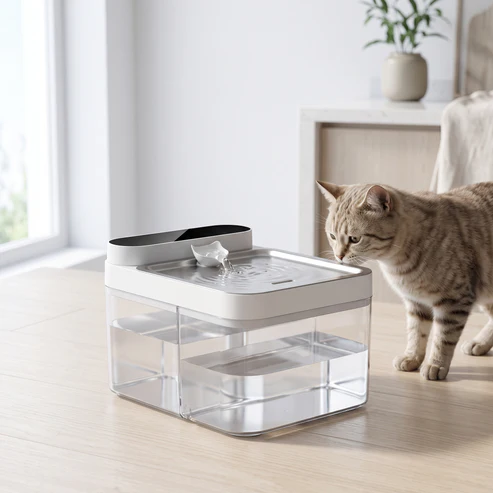
The clear HydroPurr dual-chamber cat fountain on a light wood floor in a bright modern home, water rippling in its stainless drinking tray; a grey tabby cat steps toward it and sniffs curiously. A sunlit window, a potted plant and a sideboard are softly out of focus behind.

Last Chance To Save $70 Before This Batch Sells Out.

  • Two sealed tanks — your cat's spit never touches the clean water.
  • The used water drains away once a day. It never loops back through the pump.
  • No carbon filters. Ever. No monthly tax.
  • No pink slime. No 25-minute teardown. Rinse a screen — that's it.
  • Cat-drink guarantee. Every penny back if she won't use it.
I'm Ready — Send Me HydroPurr →

Cat-Drink Guarantee: If she doesn't drink, you get every penny back.

Heads up — we're a small team and our batches keep selling out faster every month. The next one ships weeks behind this one. Either you grab one now, or you're back to scrubbing pink slime out of plastic next Sunday.

Secure checkout·Return shipping
Get HydroPurr
Cat-drink guarantee
Order →