Top Vet Warning: Your Cat's Water Fountain Is Quietly Destroying Their Kidneys. And No Filter Can Stop It.
"Every owner who 'upgrades' to a fountain thinks they've solved the problem. Most have made it worse." Dr. Hannah Cole, DVM

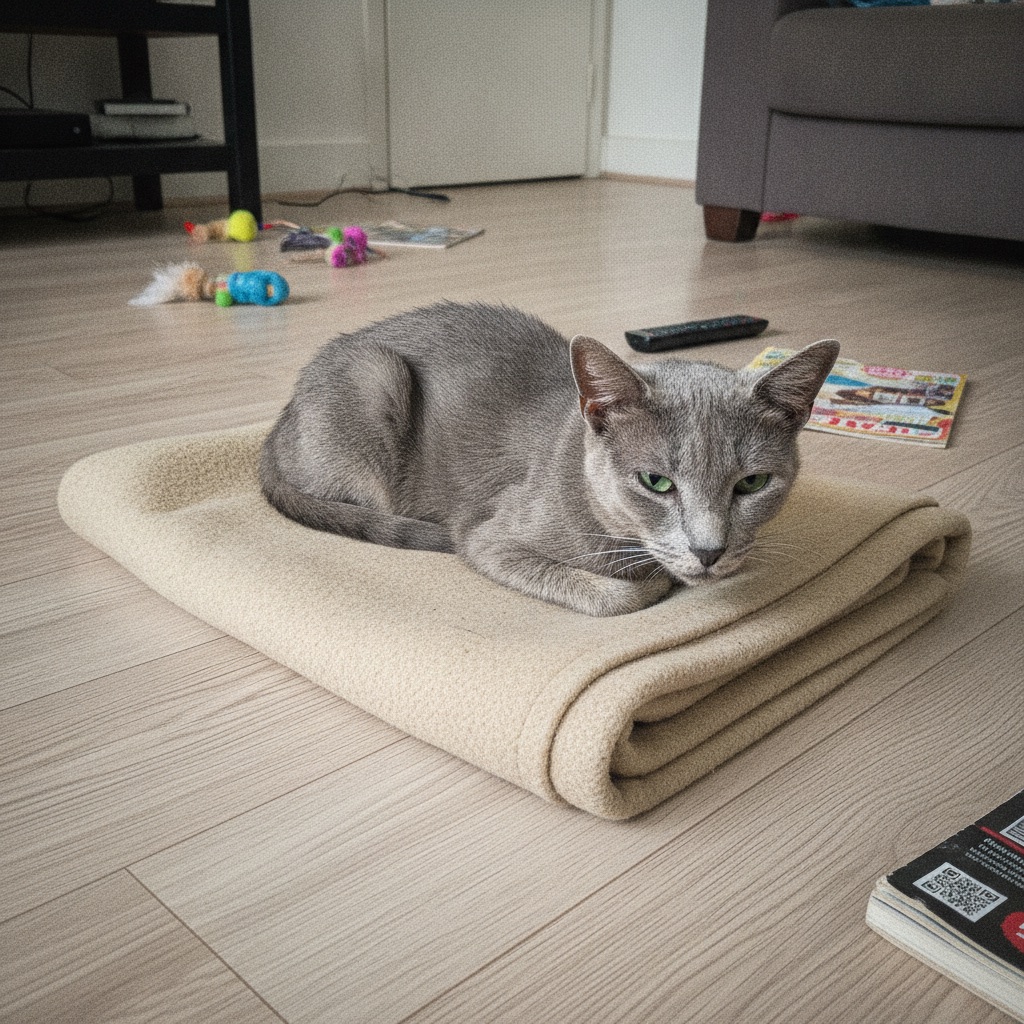
If you bought your cat a water fountain, what I found is going to make you angry.
There's a flaw in nearly every fountain sold today: the $20 ones and the $150 "hospital-grade" ones alike. It's invisible. And it quietly pushes cats toward the disease I diagnose more than any other.
I'm Dr. Hannah Cole. I've been a cat vet for fifteen years. Three months ago, one patient changed how I practice. And it started with a cat who simply would not drink.
Her name was Luna
Luna is a ten-year-old Russian Blue. Three months ago, her bloodwork came back showing the early stages of kidney disease: the exact moment hydration matters most. And her owner had already done more than most owners ever do.
She'd started with a plastic fountain. Luna wouldn't drink from it at all. Not once. So she upgraded to a stainless steel one. Luna drank from it a single time, then ignored it. So she spent a small fortune on the top-of-the-line model: a multi-stage filter and a built-in UV light, the "hospital-grade" one the box promised would keep the water pure.
That one, Luna actually used. For about a week. Then she stopped, too.
Three fountains. $350 down the drain. And Luna was back to drinking from the faucet, from water glasses, from the shower floor. Anywhere but her fountains. Meanwhile, with her kidneys already struggling, clean water was the one thing she needed most.
"I clean them every week," her owner told me, near tears. "I don't understand."
So I asked her to bring all three in. The moment she set them on my counter, I could smell them: a flat, swampy, aquarium smell. They looked perfectly clean inside. They did not smell clean. So I decided to find out what was actually living in them.
I swabbed all three. Here's what was growing in Luna's water.
I swabbed each fountain and cultured the swabs. Forty-eight hours later, the petri dishes looked like this:
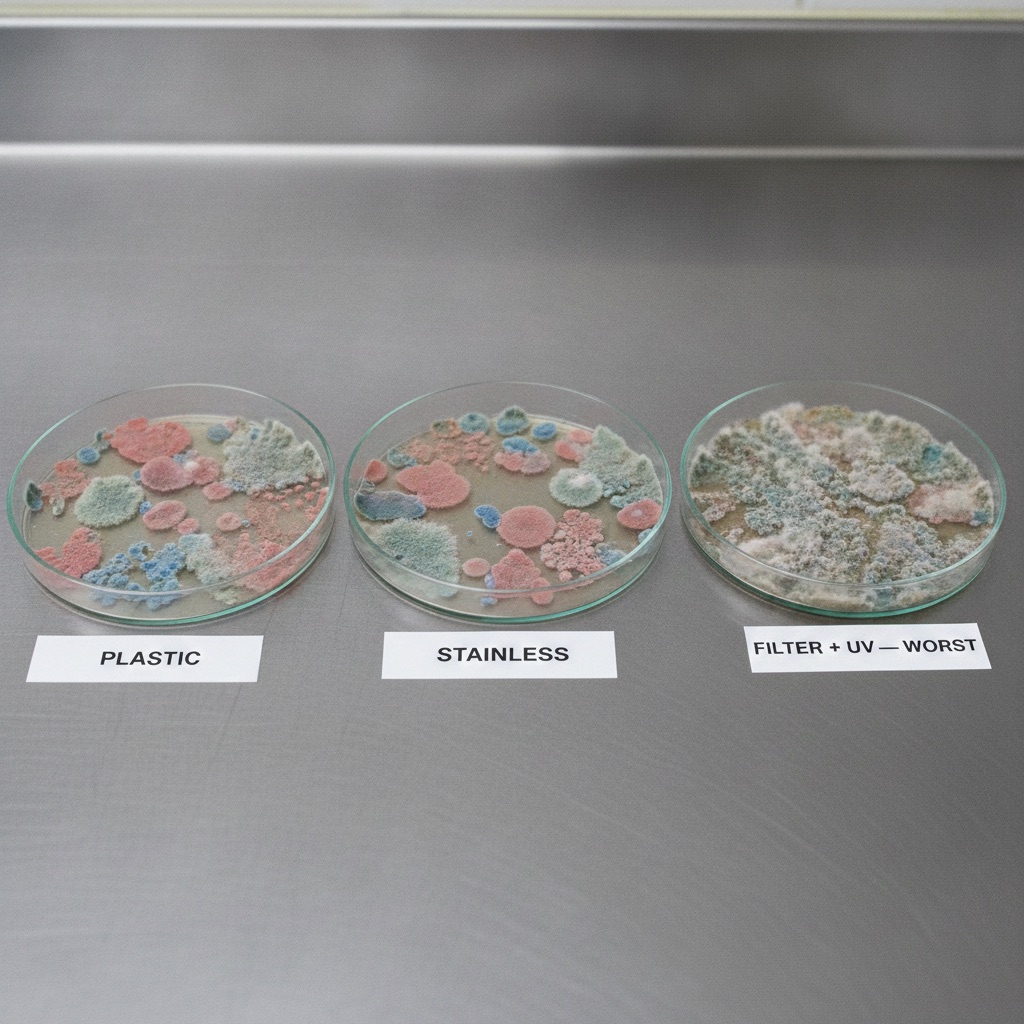
Serratia marcescens, the pink slime. Pseudomonas. Several molds. All of it, crowded together, in the water Luna was supposed to drink every day.
And the dish that scared me most was the one from the most expensive fountain: the filtered, UV one. By far the worst of the three.
They'd looked spotless inside. But that aquarium smell had to be coming from somewhere, so I opened the premium one up. This is what came out of its filter and the inside of its pump:
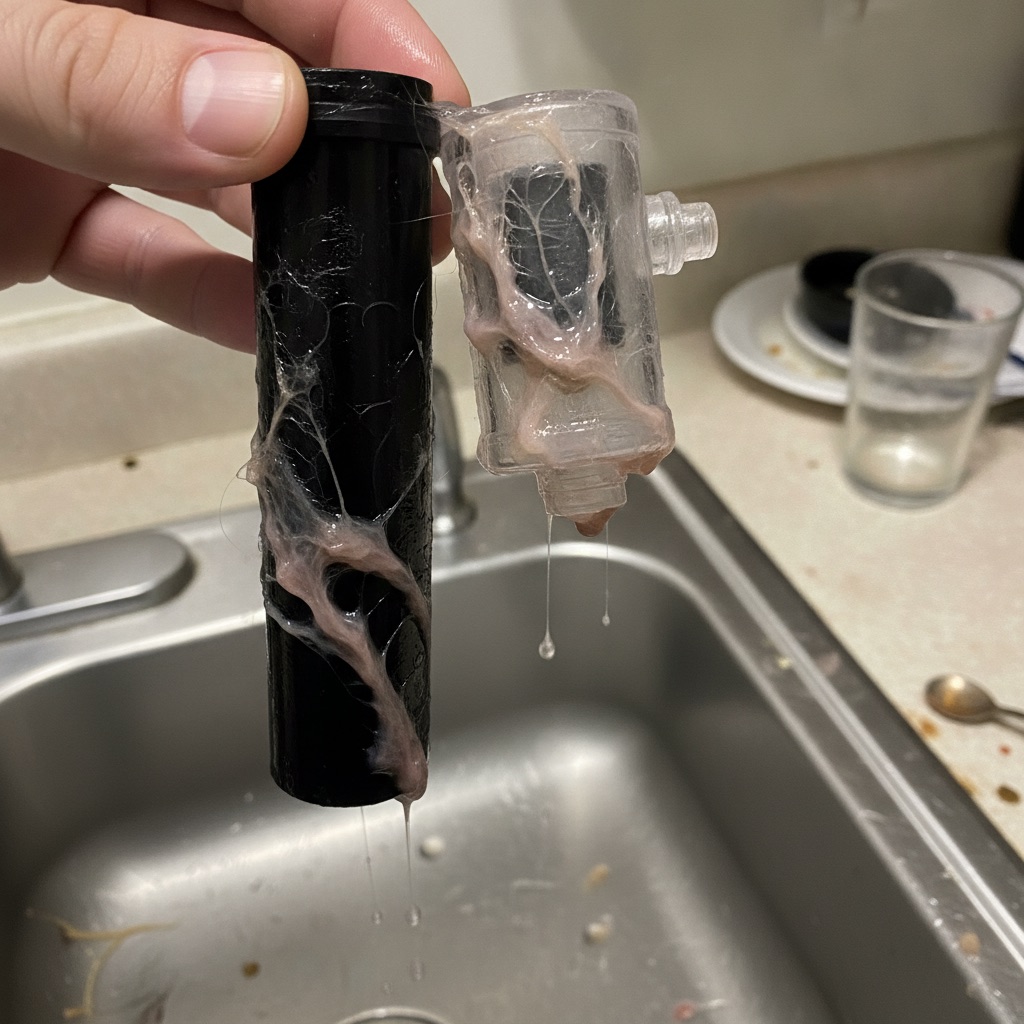
That is the inside of a fountain its owner cleaned every week. That is the water Luna walked away from. And the water she'd have been drinking if she hadn't.
There's one fountain that doesn't do this. Let me show you →But first, here's exactly why every other one fails.
It's not dirty because she didn't clean it. It can't be cleaned.
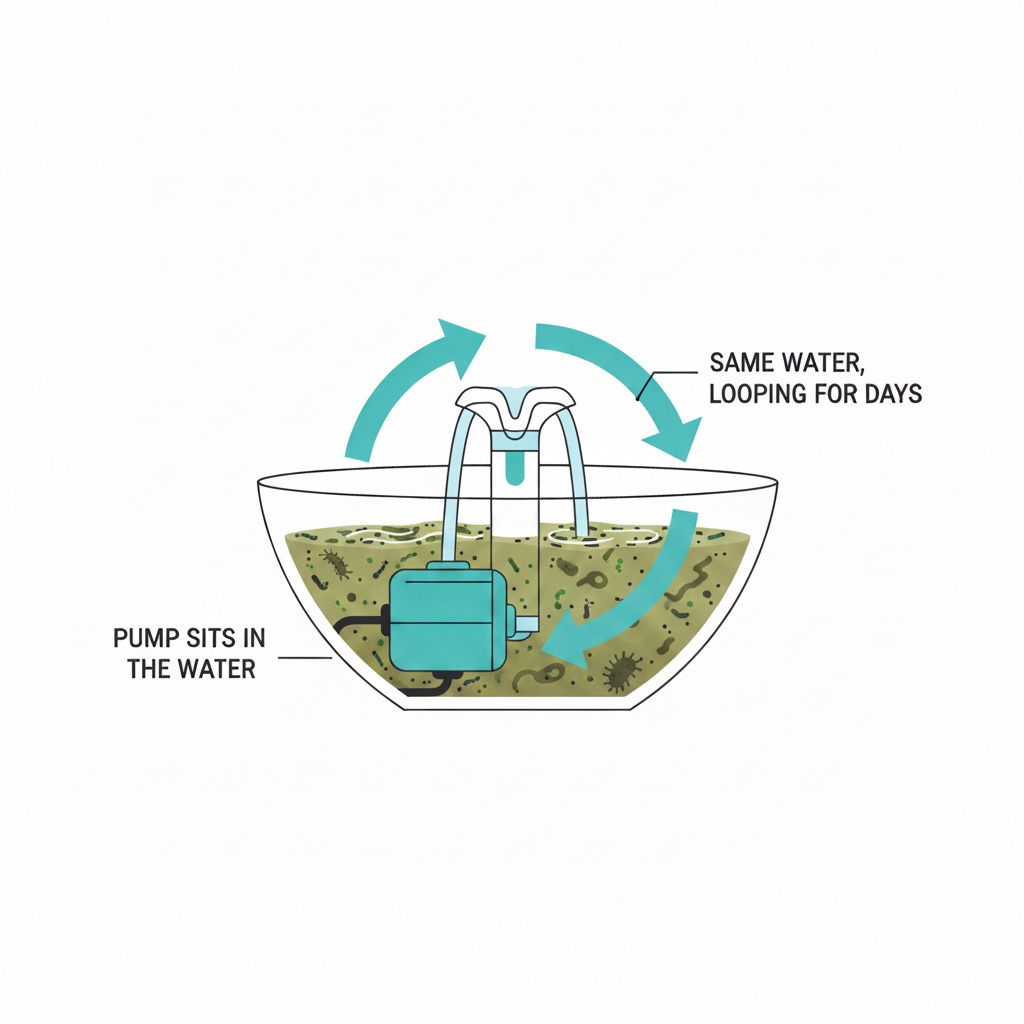
Every fountain on the shelf, whatever the shell, is the same machine inside: a loop. A pump sucks the water down and pushes it back up, hundreds of times a day. The same water. For days. Everything your cat leaves behind (saliva, shed fur, the crumbs off her chin) never leaves. It just goes around. And around.
The pump sits in that water, warming it a few degrees: the exact temperature bacteria love. Biofilm grows in the seams you can't open. You're not cleaning that water by running the pump. You're stirring it.
So why was the filtered, UV fountain the dirtiest of the three?
Because the two features Luna's owner paid the most for don't do what the box promised.
The carbon filter doesn't kill bacteria. We've known this since 1977, when a study in Applied & Environmental Microbiology found activated-carbon filters had no significant effect on the number of bacteria in the water. Carbon strips out the chlorine that was keeping tap water safe, then sits there as the warmest, wettest, most porous surface in the whole machine: the perfect place for bacteria to settle. It doesn't filter the slime out. It gives it a home.
And it's worse than useless. A 2021 study found activated-carbon filters can actually release more bacteria than goes in: in one test, up to twice as much of an opportunistic pathogen in the filtered water as in the tap water feeding it. The cartridge Luna's owner dutifully replaced every two weeks, believing it protected her cat, was quietly seeding the water.
Sources: Fiore & Babineau, Applied & Environmental Microbiology (1977) · activated-carbon bacterial-release study, Environmental Science: Water Research & Technology (2021).
And the UV light? UV simply doesn't work on most of the bacteria and mold that grow in these fountains. It's sold as "sterilization," but the weak dose and split-second exposure inside a little pet fountain leave the colonies that matter alive, while the same water keeps looping past it all day long. An expensive light. Not a solution.
This is why so many cats end up in kidney failure
It's not just my exam room. Veterinary clinics everywhere are full of cats with kidney disease. Up to 80% of older cats develop chronic kidney disease, but I'm starting to see it in younger cats too.
Here's what most owners never realize: a cat's sense for water is far sharper than ours. They have receptors we don't. And when water is fouled with biofilm and bacteria, even at levels you can't see or smell, they know. So they do the one thing that kept their ancestors alive: they walk away.
That wasn't Luna being picky. That was Luna refusing water she could tell was filthy. And a cat who won't drink enough is a cat sliding straight toward the disease she'd just been diagnosed with.
And honestly? We don't even fully know what a lifetime of drinking that bacteria, biofilm, and mold does to a cat. The research barely exists. But "we're not sure how much harm it does" is not a sentence I'm willing to accept about the water my patient drinks every single day.
The only question that actually matters
So I stopped asking "which fountain is best," and started asking the one thing that decides everything:
Does the water your cat already drank from ever go back through the pump?
If it does (any brand, any filter, any UV light), you have the loop. You have the slime. And your cat can tell.
I went looking for a fountain that answered "no." I found one.
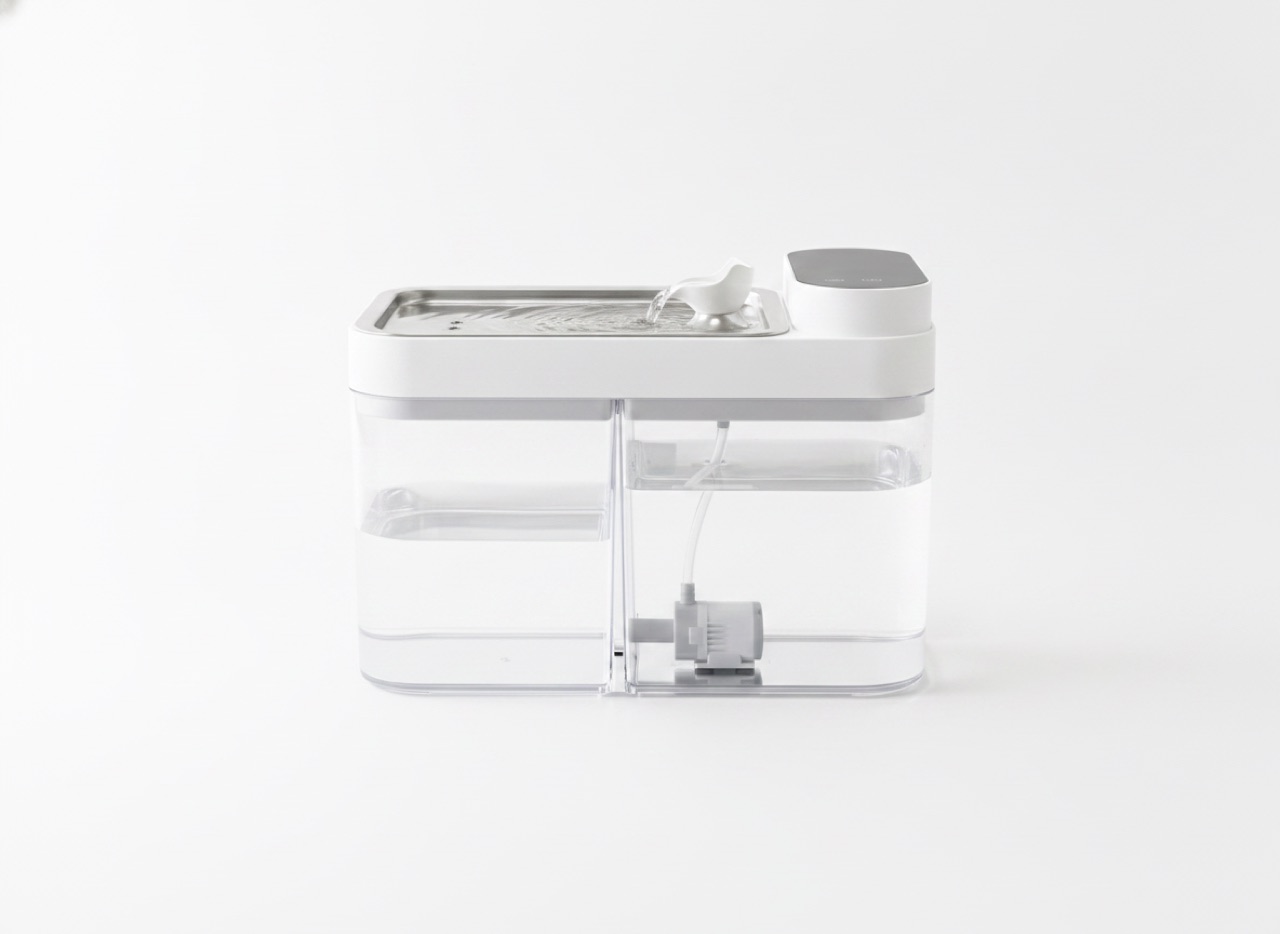
It's called HydroPurr, made by a small brand named Tenace. It isn't a better version of the same machine. It's a different machine.
- Two sealed tanks: clean water and used water never touch.
- The pump sits in the clean tank only. The water your cat drinks from never goes back through it.
- A stainless steel bowl: the only thing her chin touches.
- Used water drains one way into a separate tank, and never loops back.
- No carbon filter to rot. No UV gimmick. Just fresh, clean water: the kind a cat will actually drink.
I didn't run a study. I gave one to Luna.
I bought a HydroPurr with my own money and gave it to Luna's owner. Luna was about as hard a test as exists: she hadn't willingly used a fountain in years. I honestly didn't expect much.
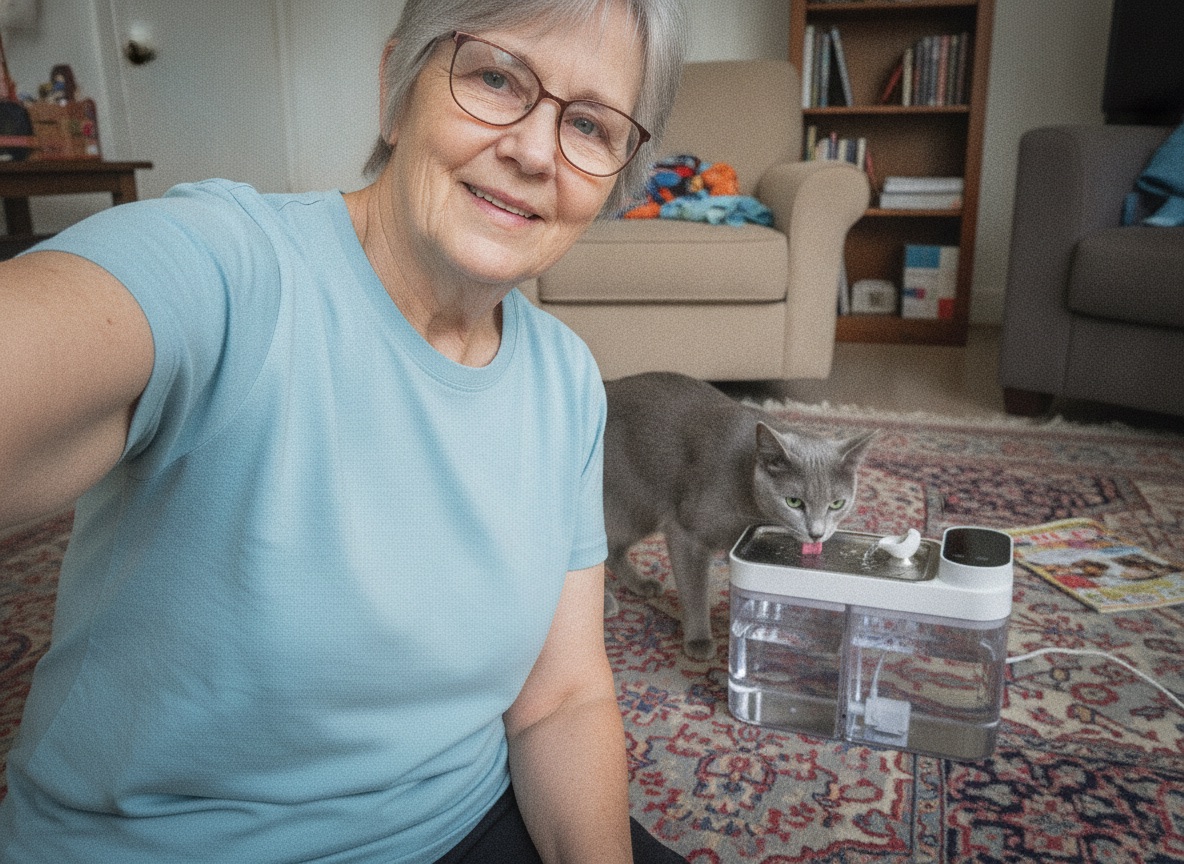
Three days later, her owner sent me the picture above: Luna, drinking from the new fountain, on her own. We re-ran her bloodwork a few weeks later, and for the first time in a long time, her kidney values had improved.
But I have to be honest with you. Because it's the whole reason I'm writing this.
Luna got a second look. Most cats don't. That's why I'm not waiting for your cat's bloodwork to look scary before I tell you this.
Let me be straight with you
I'm not affiliated with Tenace. I don't earn a cent if you buy one. It's a small operation: small batches, and sometimes a wait.
But after everything I've swabbed, cultured, and pulled apart, it's the only fountain I trust: both for my clinic, and for my own cats at home.
I just wish I'd found it in time to put one in front of Luna five years ago.
Owners keep asking me where to get one, so here it is: it's sold straight from the maker, not the cheap copies on Amazon, and it comes with a 60-day, drink-it-or-your-money-back guarantee. Tenace is a tiny operation, so I'll tell you what I tell my own clients: don't put it off. The 60-day guarantee means the only real risk is another month of the old bowl.
You don't have to wait for the 3 a.m. call Luna's owner almost got. The cheapest time to fix this is now. While your cat's kidneys are still healthy.
See the fountain I recommend →Direct from the maker · 60-day money-back guarantee